The Broncos’ state championship victory
The Journey CollectionThe Broncos’ state championship victory is both a last-second athletic triumph and a communal rite of belonging. Played before a packed stadium, it tests whether the Clarendon team will be defined by an intimidating deficit or by the heart and discipline that brought it there. Travis McCoy’s presence gives the game an additional stake: he is no longer merely a celebrated former player, but a returning member of the community, a mentor to the Broncos, and a father whose relationship with Max is sealed in the aftermath of the win.
Setting and Stakes
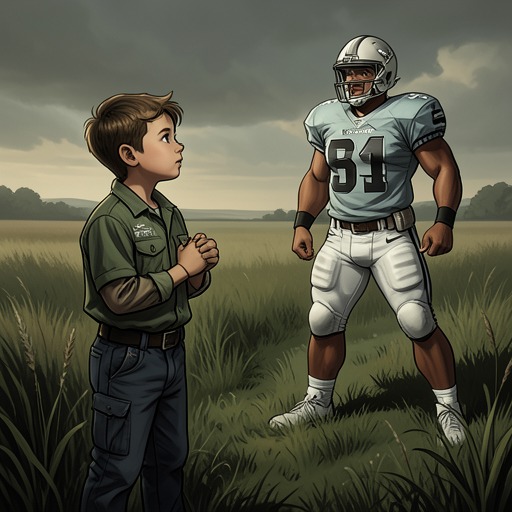
The championship carries the weight of Travis McCoy’s past and his new life. Earlier, at the Clarendon homecoming rally, he had reentered the world of the school football program, hearing the fight song and seeing the crowd gathered in the gymnasium as he remembered the Friday afternoons when he had both hated and loved being watched. At Darrell K. Royal Texas Memorial Stadium, he brings Penelope Stone, Max, Russ McCoy, and Nadine to seats behind the team and directly on the fifty-yard line, using his status as a University of Texas alumnus so Max will not miss a moment of the game.
The setting also links local football to public ritual. The Broncos win the coin toss and elect to receive the ball, while Travis quietly marks the beginning of the contest with “Here we go, boys.” The stadium is not simply a neutral playing field: it is where a small-town team is seen, judged, and supported by its community. The championship therefore places athletic performance beside family memory, civic pride, and the question of whether Travis can belong at home without abandoning the identity football gave him.
Collapse and Halftime Response
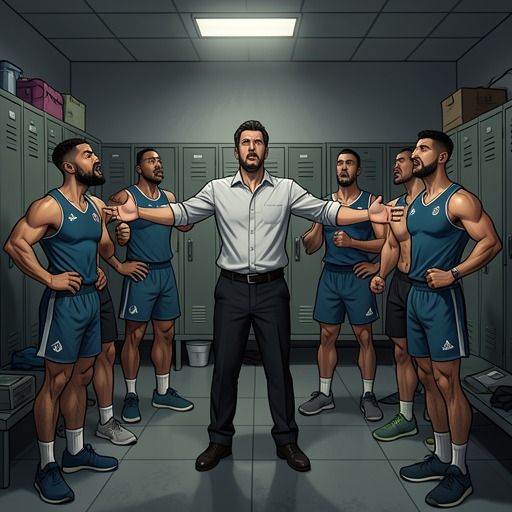
The opening half goes badly for the Broncos. The Panthers score first, add the extra point, and then capitalize on a series of breakdowns. A forceful snap flies over Cody’s head, allowing the Panthers to recover the ball, and by the end of the half they have established a fourteen-point lead. When the buzzer sends the teams to the locker rooms, the Broncos are exhausted, intimidated, and emotionally withdrawing from the contest; every player turns away when Travis enters.
Travis refuses to let the deficit become an excuse. He orders the players to look at him and insists that they can win, but not with their defeated attitude. When Andy argues that the Panthers are bigger and faster and that he cannot hold the ball before being tackled, Travis concedes the physical disadvantage while rejecting its supposed meaning: greater size and speed do not make the Panthers better. He reminds the players that they have already beaten teams with those advantages.
The turning point comes when Cody identifies the missing quality as “Heart.” He refuses to discard the ten years of work that brought the team to the championship merely because its opponent is larger. His standard is not an unrealistic guarantee of victory; if the Broncos give everything and still lose, they must at least leave the field knowing they put everything on the line. Trey then rejects quitting, and Andy recalls the team’s earlier comeback against the Bobcats, proposing that the Broncos teach the Panthers how Clarendon plays football. One by one, the rest of the team rises and cheers. Travis remains with them until they return to the field, striking each player on the back of the head as encouragement, while Coach Reynolds explains that many of the boys have never experienced a stadium of this size except on television.
The Final Drive and Two-Point Conversion
The Broncos’ recovery is measured in inches and first downs rather than in a sudden reversal. They work their way down the field while the clock falls from three minutes to two and then one. With thirty seconds remaining, Cody takes the snap and throws deep. Andy catches the ball in the end zone, producing the touchdown that brings the Broncos within reach of overtime or victory.
The score does not yet settle the championship. Russ points out that the team must still make the extra point to force overtime, but Travis recognizes that the exhausted Broncos cannot afford another quarter. He explains that they must attempt the two-point conversion: the championship is precisely the moment when taking a risk matters most. With one hand on Penelope’s back and the other on Max’s shoulder, he watches Cody receive the snap, stumble backward, search unsuccessfully for an open receiver, and then run. Cody dodges the linemen, spins away from a linebacker, finds a gap, and falls across the goal line. The referees raise both arms, confirming that the two-point conversion is good.
Victory and Recognition
The stadium’s silence breaks into a deafening roar. Strangers embrace, tears of joy appear throughout the crowd, and the players remove their helmets along the sideline. Each Bronco looks toward Travis and nods. He answers by bringing one hand to his chest, acknowledging that the victory belongs not only to the scoreboard but also to the shared labor and faith connecting the team, its mentor, and the town.
The players’ recognition completes Travis’s return home. At midfield, he had told them that the crowd’s support was for them because they had worked hard and earned the community’s respect; after the game, their gesture returns that respect to him. Football has ceased to be only the arena in which Travis once performed. It has become the language through which he teaches courage, receives acceptance, and participates in a community that still remembers him.
For Max, the victory produces the most intimate consequence. He climbs onto the bench, wraps his arms around Travis’s neck, and whispers, “Thanks, Dad.” Travis had hoped for that moment but had not wanted to force it. Max’s words show that the boy has begun to trust Travis not to leave, not to hurt Penelope, and, above all, to love him. The public championship thus generates a private recognition: the team’s triumph coincides with Max’s acceptance of Travis as his father.
Lasting Consequences
The championship victory becomes the emotional bridge between Travis’s public role and his family commitments. Soon afterward, he proposes to Penelope, declaring that he has loved her since adolescence and that she has always owned his heart and soul. His next major request is that Max’s last name be legally changed to McCoy, because he wants the boy to share the family name when Travis and Penelope marry. The request makes explicit what the championship has already dramatized: Travis is seeking not a return to former glory but a durable place within a family.
That movement culminates in the wedding staged on the football field. The field is transformed with a white wooden arch at the fifty-yard line, candelabras, rows of chairs, lanterns, balloons, and an ivory aisle runner. During the ceremony, Travis, Penelope, and Max light the eternity candle together as a family. The championship had publicly welcomed Travis back through football; the wedding converts that belonging into a formal household bond. Later, an ultrasound photograph announces another expansion of the family, showing that the life gathered around Travis now extends beyond the game and into a future of marriage, parenthood, and shared continuity.
Narrative Significance
The Broncos’ victory reverses the value of the championship from apparent defeat to earned triumph, but its deeper reversal concerns Travis’s identity. He once experienced football as the defining center of his life and later had to confront what remained when professional performance ended. In Clarendon, the field offers a different answer. The important achievement is not simply that the Broncos win after trailing by fourteen points; it is that Travis uses his knowledge of football to help young players recover their courage without making himself the story.
The event also gives the novel its clearest expression of “heart over the scoreboard.” The players are praised as men because they persist under pressure, while the community’s embrace makes victory meaningful beyond competition. The final conversion, the players’ nods, and Max’s whispered acknowledgment form a sequence of public achievement, communal recognition, and private family acceptance. The Broncos win a state title, but Travis wins something more lasting: a home in which football, fatherhood, love, and responsibility no longer compete for his loyalty.